Trump uses a bridge as leverage until US is 'compensated' by Canada for 'everything they've given'

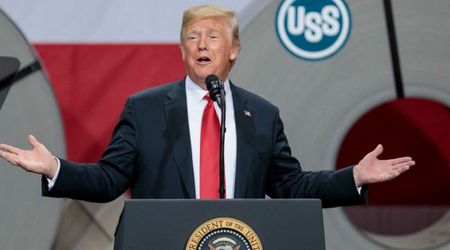
U.S. President Donald Trump has issued fresh threats to block the opening of the Gordie Howe International Bridge that would connect Windsor, Ontario, and Detroit, Michigan, marking an important border crossing between America and Canada. While the President demands proper compensation, "Fairness and Respect" for everything the country has given to its neighbor, economists warn that any delay in the opening of the bridge would hurt the 'Motor City' economically, as the crossing is important for commercial trucks.

In a 299-word post on his social media platform Truth Social, Trump complained that Canada has treated the U.S. "very unfairly for decades," and complained that the bridge was built "with virtually no U.S. content." He also criticized Prime Minister Mark Carney over "wanting to make a trade deal with China," and demanded that the U.S. should own at least "half of this asset." However, in typical fashion, the President did not provide any explanation on how he would block the opening, but he stated that negotiations would begin immediately.
The Gordie Howe Bridge has been entirely funded by Canada's federal government, but the $6.4 billion bridge is under the public joint ownership of Canada and the state of Michigan. The Windsor-Detroit Bridge Authority is overseeing the project, and major construction is complete. Only the final testing is remaining, and expected to open later this year, the bridge will provide another route across the busy international border area between Detroit and Ontario, especially for commercial trucks. “You have auto parts being manufactured on one side of the border and then shipped to the other side of the border to be finished in the manufacturing process,” Chris Douglas, professor of economics at the University of Michigan-Flint, told WNEM5. He added that the two economies are intertwined and a prolonged delay in opening the bridge could have a major impact.

Douglas added that if the supply chains are disrupted, consumers will be hurt. “If those supply chains get disrupted, then you see what we saw during the pandemic, where there’s random shortages,” he explained. “You need to buy a new car. You can’t find a new car because the part to Canada can’t be shipped to the US. You see prices go up because of the shortage of supplies, which pushes prices up. So consumers just get a headache in terms of, I want to buy something. It’s either got way up in price, or it’s just a shortage," Douglas further explained.

The economist added that there could be long-term implications as well if President Trump fails to make an agreement. “The longer-term issue is, well, if truck traffic increases, the passenger car traffic increases, maybe that will outgrow the Ambassador Bridge,” said Douglas, adding that many Americans who live in Southwest Michigan work in Canada and vice versa, so if the traffic is disrupted, those workers' lives will be disrupted as well. He cautioned that the issue will probably end up in court if Trump persists in keeping the bridge shut.
More on Market Realist:
Trump’s 'One Big Beautiful Bill' could have a major impact on higher education this year
Trump's tariffs are hurting American consumers more than exporters— here's how much they're paying
Top economist warns 'crisis will get worse' if Donald Trump follows through on his threat