
Why Crypto Pre-IPO Perpetuals Could Change How Companies Go Public
Cryptocurrency derivatives offer a highly transparent alternative to the opaque pricing models that have dominated Wall Street for decades.

July 2 2026, Published 4:16 p.m. ET

The traditional public listing process relies on a closed loop of investment banks and institutional allocators. This system routinely results in systematic underpricing, a dynamic that guarantees first-day price spikes for favored clients while sidelining retail participants.
With the global private equity market valued at $13 trillion, restricting retail access to these assets represents a significant barrier. If pre-IPO perpetual contracts can deliver more accurate price discovery than these conventional roadshows, the entire mechanism for bringing companies to the public market faces a structural shift.
By allowing market participants to trade expected valuations before a stock officially lists, cryptocurrency derivatives offer a highly transparent alternative to the opaque pricing models that have dominated Wall Street for decades.
The Power of Crowd-Sourced Valuation Signals
Price discovery works best when it incorporates constant feedback from a broad participant base. Continuous perpetual pricing operates outside the confines of traditional trading sessions, generating real-time valuation signals that respond immediately to market conditions.
Data from Stork Labs illustrates this effectively, noting that Cerebras perpetuals priced the stock almost perfectly ahead of its opening trades on the Nasdaq, achieving this accuracy entirely without investment bank intervention.
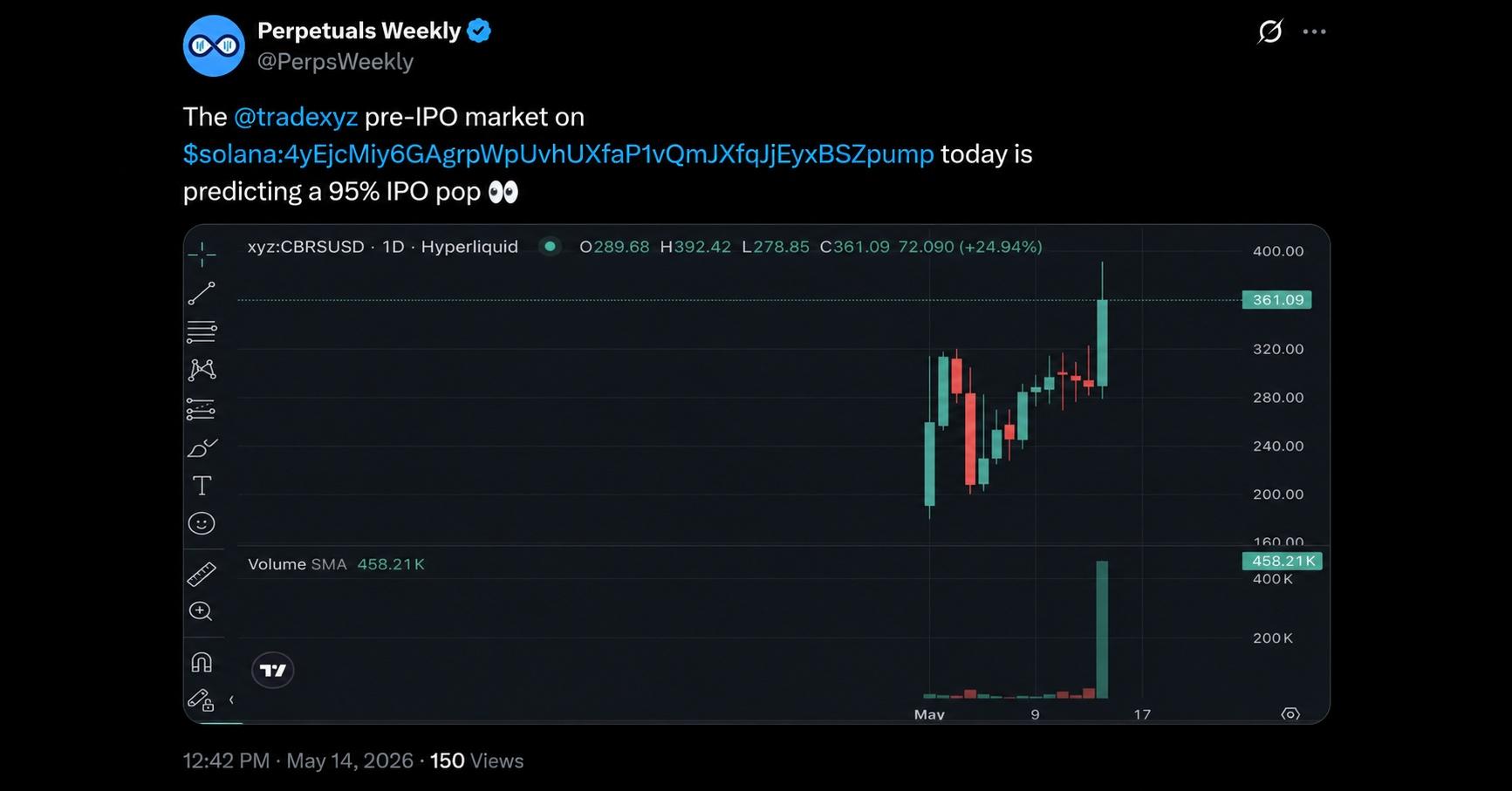
This level of market efficiency indicates a clear demand for alternative trading infrastructure. As Shunyet Jan, Head of Spot and Derivatives Business at Binance, observed, The momentum we saw in the first days of this category launch is a strong signal that users are looking for new ways to access major market narratives through crypto-native products."
"Reaching more than $280 million in cumulative trading volume within five days of our first listing gives us confidence in both the appeal of Pre-IPO perpetuals and our broader strategy to evolve Binance into a financial super app. As we democratize access to a wider range of financial opportunities, that vision is clearly resonating with users," continued Jan.
Broadening the Market Scope: From Tech to AI
This shift toward early price discovery extends well beyond a single high-profile technology firm. The market for pre-listing exposure is expanding rapidly across the most closely watched sectors in private equity.
Recent category data highlights this distribution, showing SpaceX perpetuals accounting for 79% of trading volume, while artificial intelligence developers OpenAI and Anthropic capture 11% and 9.5% respectively.
Permitting the broader market to weigh in on the corporate worth of these private AI companies provides tangible valuation metrics long before a traditional S-1 roadshow even begins. As global attention around artificial intelligence accelerates, these contracts allow participants to express a directional view on industry leaders without requiring accredited investor status or massive capital minimums.
Instead of relying on selective private funding rounds to estimate a corporate valuation, traders can aggregate public sentiment and financial expectations into a single, tradable contract that updates continuously.
Liquidity and the 24/7 Discovery Engine
Moving these markets onto cryptocurrency rails introduces distinct structural advantages over legacy equity systems. Because these pre-IPO contracts trade continuously, they eliminate the severe gap risks typically associated with weekend news cycles and delayed Monday openings. The depth of capital forming around these instruments demonstrates that robust activity exists well outside traditional banking hours.
Across the broader digital asset ecosystem, traditional finance perpetuals have surged to over $7 billion in daily volume on Binance alone. Within this expanding sector, the exchange processed over $280 million in cumulative volume during the first five days of its category launch.
Pre-IPO contracts are designed to transition smoothly to reflect live market performance once the underlying company begins trading on public secondary markets. This turns an anticipated event into an active and real-time trading opportunity. It’s a consistent liquidity profile that shows that retail and institutional participants are increasingly comfortable using synthetic derivatives to manage exposure across different asset classes.
What This Means for Future Issuers
Companies preparing for their own public debuts must recalibrate how they approach the listing process. Pre-market valuation signals are now entirely public, highly liquid, and increasingly difficult for underwriters to ignore.
Corporate treasurers and chief financial officers will likely use these on-chain pricing metrics to benchmark their offerings against the broader market consensus. When a decentralized derivatives market establishes a firm price floor based on millions of dollars in traded volume, investment banks lose their monopoly on determining what a company is actually worth.
A New Infrastructure for Public Listings
The emergence of these continuous trading instruments represents a direct challenge to the legacy mechanics of capital formation. Pre-IPO perpetuals have moved from an experimental concept to a functional mechanism for establishing corporate value before a single share changes hands on a public exchange.
As trading volumes increase and the underlying infrastructure matures, these contracts could eventually serve as the standard price discovery infrastructure. Rather than relying exclusively on institutional roadshows to gauge demand, the financial sector may increasingly depend on platforms that can support continuous, open-market valuation signals to dictate the terms of future public offerings.