
Privateering in Cyberspace: Rethinking the Letter of Marque for the Digital Age
Yuri Vanetik, U.S. Congressman Tim Burchett and Rep. Mark Messmer recently introduced the Cartel Marque and Reprisal Reauthorization Act of 2025.

Dec. 12 2025, Published 8:12 p.m. ET

According to Washington, D.C.-based attorney and Lincoln Fellow at the Claremont Institute, Yuri Vanetik, U.S. Congressman Tim Burchett (R-Tenn.) and Rep. Mark Messmer (R-Ind.) recently introduced the Cartel Marque and Reprisal Reauthorization Act of 2025. The legislation would authorize President Trump to commission privately armed and equipped actors to seize the persons and property of any cartel, cartel member, or cartel-linked organization.
Centuries ago, when the world’s battles were fought by sail and cannon, governments turned to private citizens for help. Through instruments known as Letters of Marque and Reprisal, sovereigns authorized private ships to capture or disable enemy vessels. These “privateers” blurred the line between soldier and entrepreneur — advancing both national defense and personal justice.
In the 21st century, we face a different ocean: cyberspace. And the pirates of this era do not fly flags; they hide behind screens, algorithms, blockchain systems, and VPN anonymity. Occasionally, some of them get caught by law enforcement, but there are no Blackwater-type mercenaries or cyber-bounty hunters to disrupt their schemes. They resort to swatting, doxing, and cancelling their victims. As a political activist, I have experienced these assaults from rogue, paid grifter reporters such as Kevin Hall, formerly from McClatchy DC.
From ransomware syndicates to coordinated campaigns of online harassment, modern digital aggression is fast, decentralized, and often beyond the reach of traditional law enforcement. Even as governments and platforms scramble to keep up, ordinary citizens — victims of hacking, defamation, or “cancel culture” mobs — are left stranded and often destroyed. I have warned about the dangers of cancel culture in Newsweek, explaining how it has been manipulated to annihilate the disenfranchised minorities it was intended to defend.
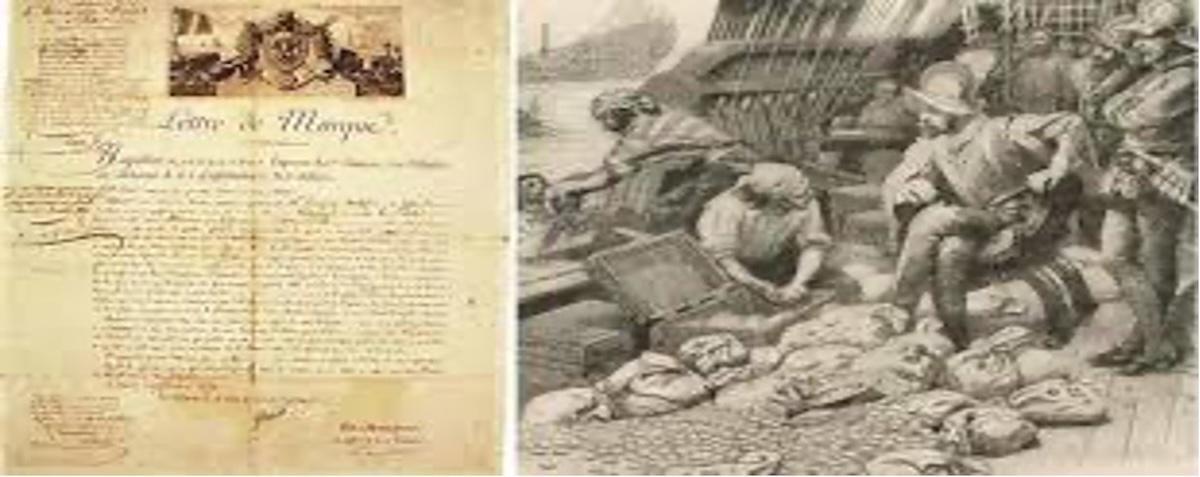
The concept of privateering does appear in some science fiction, typically in the Space Opera subgenre, where it is used to authorize "space pirates" or private military actions in interstellar conflicts. The term "letter of marque" is famously the title of the twelfth book in the Aubrey-Maturin historical novel series by Patrick O'Brian, where the protagonist, Jack Aubrey, leaves the navy to command a ship as a privateer.
Could an ancient idea, adapted to modern ethics, provide a path forward? Could a digital version of the Letter of Marque empower individuals and private entities to defend themselves and others in a lawful, regulated way?
The Letter of Marque originated in the Middle Ages as a kind of legalized revenge. Merchants who lost ships or goods to pirates petitioned their sovereigns for permission to recover damages by seizing enemy vessels. Over time, these reprisal rights evolved into formal state commissions. By the seventeenth century, privateers such as England’s Francis Drake or France’s Jean Bart sailed under legal charters that authorized them to disrupt enemy commerce, enriching themselves while advancing national interests.
The United States embraced the practice during the Revolution and the War of 1812, when Congress issued hundreds of such licenses. Privateering waned after the Declaration of Paris of 1856, which outlawed the practice among major powers. However, the U.S. never signed that declaration, and the Constitution still grants Congress power to “grant Letters of Marque and Reprisal.” That dormant clause, once tied to maritime warfare, may yet find new relevance in the digital realm. It has certainly gotten recent attention and a makeover from the Bill introduced by Reps Burchett and Messmer.
Today, the high seas have been replaced by the boundless networks of cyberspace. Hackers, trolls, unethical reporters such as Angela Hart, Kevin Hall, Ben Weider, and digital mobs move faster than bureaucracies. They smear people and institutions with impunity, invoking the protections of the controversial Sullivan case and the First Amendment. Laws such as the Computer Fraud and Abuse Act (18 U.S.C. § 1030) prohibit private citizens from “hacking back,” even when defending against theft or harassment. Meanwhile, tech platforms act as both judge and jury in regulating speech, often too slowly or inconsistently to stop real harm.
The result is a vacuum of justice. Victims of doxxing, staged reputation attacks, and coordinated harassment, often under the banner of “cancel culture,” face consequences that destroy careers, families, and undermine human dignity.
According to the Pew Research Center, 41 percent of U.S. adults have experienced some form of online harassment, and most say platforms respond inadequately. Law enforcement is often ill-equipped to investigate anonymous or cross-border abuse. The social internet, in effect, has become an ungoverned sea.
A modern Letter of Marque could be the Cyber Letter of Marque and could take two forms. First, at the national level, governments might authorize licensed cybersecurity firms to disrupt or neutralize specific hostile networks, such as ransomware operators, foreign disinformation campaigns, or botnets. This could be done under supervision and be governed by international law. Second, at the individual level, a regulated framework could empower victims of cyberbullying, defamation, or digital stalking to work with certified “digital defenders” to identify, expose, and counter malicious actors – be they fake hostile media campaigns run by media rogues such as Kevin Hall or Russian bot farms funded by hostile sovereign powers.
In both cases, the goal would not be vigilante justice but lawful, auditable reprisal. That is a form of defensive accountability. Private actors, once licensed, could act within defined parameters: tracing doxxing networks, compelling meaningful retractions, using lawful counter-speech campaigns, or gathering digital evidence admissible in court. Like the privateers of old, these digital defenders would operate under public authority but private initiative.
The rise of “cancel culture” illustrates how reputational warfare has moved from courtrooms to social feeds. A single defamatory post or viral falsehood can ruin a career overnight, long before truth catches up. Legal remedies — libel suits or platform complaints — move too slowly to matter. The asymmetry of harm is striking: one post on X can destroy, but years of litigation barely repair.
A modernized Letter of Marque could help rebalance that asymmetry. Imagine a system where individuals subjected to malicious falsehoods or coordinated harassment could petition a neutral agency — perhaps under a “Digital Reprisal Act” — to authorize certified private entities to investigate, identify, and counterattack within legal limits.
Such measures might include tracing bot networks, issuing verified takedown demands, or running restorative information campaigns. The purpose would not be censorship, but restoration, empowering citizens to defend reputation and truth in real time.
Delegating power to private actors carries risks. Without strict oversight, cyber privateering could degenerate into digital vigilantism. Misidentification, political misuse, or overreach could cause irreparable harm. That is why any digital Letter of Marque must be grounded in transparency, judicial review, and public accountability.
In practice, Congress could issue limited licenses subject to renewal and auditing. A registry of approved operators could be maintained, akin to private investigators or cybersecurity contractors. An independent “Cyber Court” could adjudicate complaints and verify that actions remain within lawful boundaries. International cooperation, guided by principles in the Tallinn Manual on the International Law Applicable to Cyber Operations, would ensure respect for sovereignty and human rights.
Privateering worked because it aligned incentives: states gained reach; individuals gained agency. The same balance could redefine digital governance today. Rather than letting platforms monopolize moral authority or leaving citizens defenseless, a regulated Cyber Letter of Marque could blend public legitimacy with private agility. Like armed citizenry, the symbolism of privateering in the digital realm can serve as an empowerment movement and a tacit warning to internet gangsters and their ilk.
It could enable victims of hacking, harassment, and defamation alike to reclaim a measure of justice. The ultimate goal is not revenge, but restoration — of truth, dignity, and balance. In a world where information travels faster than law, empowering citizens to fight back responsibly may be the only way to preserve both freedom and fairness online.
Yuri Vanetik is a Washington, D.C.–based attorney and Lincoln Fellow at the Claremont Institute. He previously served as Governor Arnold Schwarzenegger’s appointee to the California Criminal Justice and Lottery Commissions.