
Decoding the 9.6x Ratio: Why Derivatives Dictate Crypto Markets
Understanding this $18.63 trillion derivatives engine is mandatory for anyone looking to navigate digital assets.

May 18 2026, Published 3:30 p.m. ET

Retail investors often fixate on spot prices, assuming direct asset purchases drive market direction. The actual engine dictating digital asset valuations operates out of sight for most everyday participants. In Q1 2026, total cryptocurrency trading volume revealed a stark structural reality.
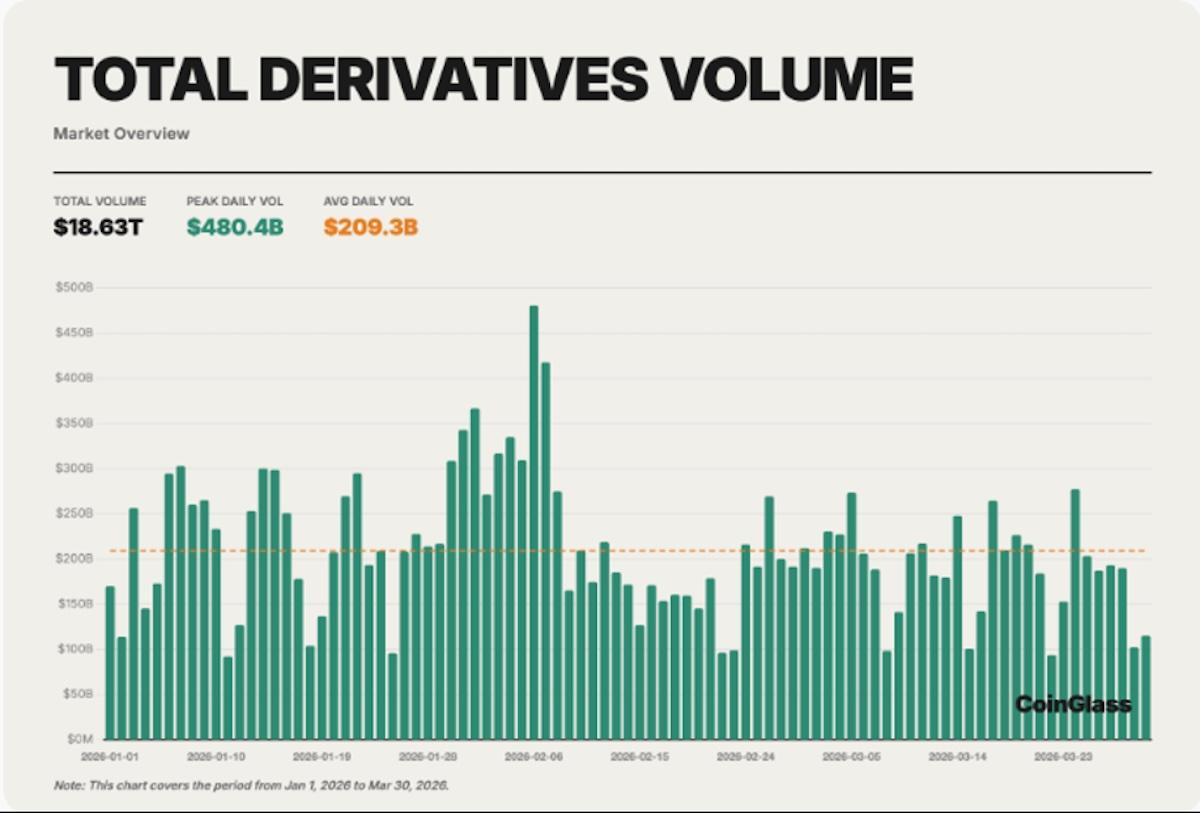
Data from CoinGlass shows the market processed $18.63 trillion in derivatives volume compared to just $1.94 trillion in spot trading. This hyper-fast derivatives environment operates on entirely different mechanics than traditional investing. Market data indicates that 81% of derivative positions are closed within 24 hours, highlighting an ecosystem built for rapid capital rotation rather than long-term accumulation.
Perpetual Futures as the Engine of Price Discovery
To understand why derivatives dwarf spot markets by such a massive margin, observers must look at the specific mechanics of perpetual contracts.
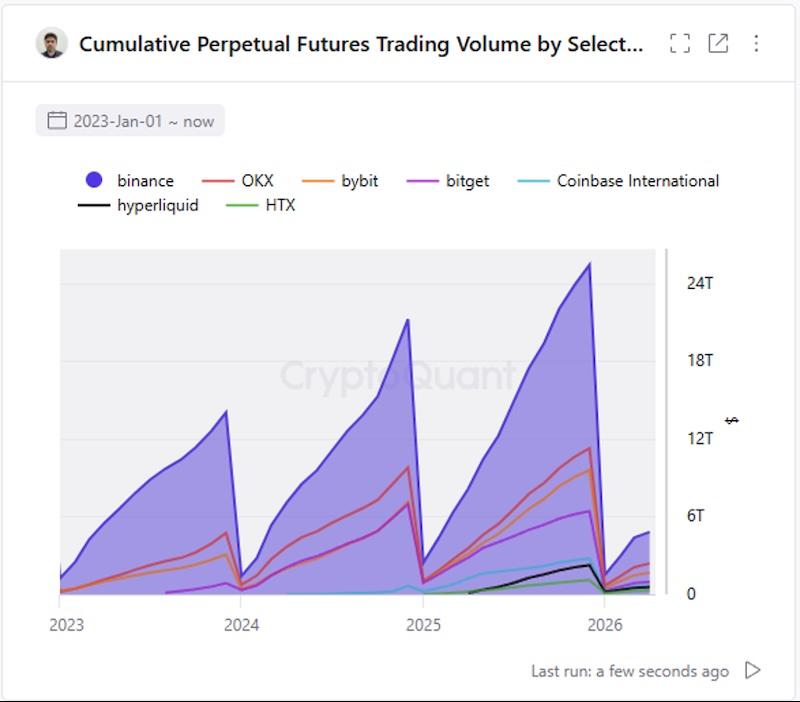
According to CryptoQuant, monthly perpetual volume reached $3.5 trillion in March 2026. That figure is more than four times larger than the $0.8 trillion processed in spot markets. The resulting 9.6x derivatives-to-spot ratio allows for extraordinary capital efficiency, empowering traders to control substantial positions with a fraction of the required upfront capital.
This leverage allows the perpetual market to lead price discovery across the entire digital asset industry. "As trading activity normalized in Q1, market structure became clearer: derivatives continued to lead price discovery, while liquidity consolidated on platforms able to support scale," notes Binance Co-CEO Richard Teng.
He emphasized that changing macro conditions often push capital toward established platforms. "In a lower-volume environment, Binance's consistent leadership across both spot and perpetual markets reflects the value users place on deep liquidity and reliable execution," Teng added.
Because these contracts never expire, traders maintain exposure indefinitely as long as margin requirements are met. The continuous exchange of funding rates ensures contract prices remain anchored to the underlying asset, creating a highly reactive pricing mechanism.
Bridging TradFi and Crypto: The 24/7 Advantage
Traditional finance infrastructure operates within rigid boundaries that leave institutional portfolios exposed during off-hours. A stark example is the COMEX gold futures market, which enforces a 49-hour weekend trading gap. If a major macroeconomic event occurs on a Saturday, institutional managers have absolutely no mechanism to hedge their exposure until Sunday evening.
Cryptocurrency derivatives platforms solved this structural vulnerability by offering constant, round-the-clock market access. This 24/7 perpetual model is now successfully absorbing traditional financial assets. By mid-March 2026, Binance TradFi perps—covering gold, silver, and equities—processed over 113 billion trades.
These instruments generated more than $153 billion in cumulative volume during the same period. Applying crypto-native infrastructure to legacy assets removes the operational friction of clearing fees and rigid roll schedules, giving market participants continuous control over cross-asset exposure.
Centralized Liquidity vs. Regulated Fractions
When comparing trading venues, a massive liquidity divide separates strictly regulated traditional exchanges from offshore cryptocurrency hubs. During Q1 2025, the CME Group reported an average daily volume of $11.3 billion for its cryptocurrency futures and options suite. This added up to 198,000 contracts. While this points to growing conventional institutional participation, it represents only a fraction of global activity.
The vast majority of the $18.63 trillion quarterly market flows directly through massive centralized liquidity hubs. Institutional participants prioritize deep liquidity when executing complex strategies with minimal slippage.
CoinGlass data from Q1 2026 illustrates this concentration perfectly. Binance captured 34.9% of the top 10 derivatives volume, processing roughly $4.90 trillion. This execution capacity was 2.2x larger than OKX, its closest competitor. Capital consistently routes toward platforms that can absorb large block orders without severely disrupting the underlying asset price.
The Future of High-Volume Digital Asset Trading
Market structure has fundamentally changed since the previous cycle. Direct spot accumulation remains important for specific investment mandates, but the heavy lifting of global pricing now happens entirely through futures contracts. The sheer scale of this activity demands highly sophisticated risk management and execution architecture.
As the industry moves deeper into 2026, the dominance of this trading layer only continues to harden. Cumulative perpetual volume for Binance alone reached $4.5 trillion in the first quarter of 2026. This execution scale sits far ahead of the $2.2 trillion recorded by OKX and the $1.5 trillion processed by Bybit. This concentration of volume and liquidity underpins how major market participants manage risk.
Modern financial market participants can no longer view cryptocurrency solely through the lens of retail spot buying. Understanding this $18.63 trillion derivatives engine is mandatory for anyone looking to navigate digital assets. The perpetual futures market dictates the pace, sets the pricing, and ultimately controls the flow of capital throughout the global cryptocurrency ecosystem.