
The $250-Per-Call Problem Silently Draining Auto Repair Shop Revenue
Every missed call costs auto repair shops $250 on average. See why 80% of callers never leave a voicemail—and how shops are closing the gap.
Sept. 23 2026, Published 3:24 p.m. ET

An unanswered inbound call means an average loss of $250 for every auto repair shop. That's not a scary number pulled from a sales deck. It's the blended value of a missed lead once you account for the average repair order and the share of callers who were ready to book. Most store owners have never actually done the math, hence the revenue drain that continues.
The number holds up because of how consistently repair work converts once a customer gets a live person on the phone. A caller dialing a repair shop isn't browsing; they have a noise, a warning light, or an inspection deadline, and they're ready to schedule. The $250 figure isn't the average invoice; it's the average invoice weighted by how often a connected call turns into a booked job.
Shops routinely underestimate this because a missed call doesn't feel like lost revenue in the moment. It feels like nothing at all - no complaint, no chargeback, no line item. The customer just quietly calls the next shop on the list, and the loss never shows up on a P&L.
What Actually Happens When a Call Goes Unanswered
The instinct is to assume a missed call isn't a lost call. The customer will leave a message or try again later. The data says otherwise.
According to AutoLeap AIR, 80% of callers don't leave a voicemail when a call goes unanswered, and 85% never attempt a second call. A missed call isn't a delayed conversation. In the overwhelming majority of cases, it's simply gone. The customer has already moved to the next name on their list before the shop even knows the phone rang.
Run the math on a shop's own call volume, and the number stops being abstract. A shop that misses just five calls a day is losing:
5 missed calls × $250 = $1,250 lost per day
$1,250 × 20 working days = $25,000 lost per month
$25,000 × 12 months = $300,000 lost per year
And that's before factoring in lifetime value - the oil changes, inspections, and referrals a retained customer generates over the years, not just the one repair order they called about. Five missed calls a day sounds modest for a busy shop. The revenue behind it isn't.
The flip side of this math is worth sitting with too: a missed call isn't only a loss, it's also a qualified lead that already raised its hand. Missed call marketing treats that signal as an asset rather than writing it off, the same call volume a shop is currently losing can become the basis of a re-engagement list instead of a dead end.
Where the Gaps Actually Are
Missed calls don't happen because a shop's team is bad at its job. They happen because independent shops built their phone systems around a call volume and a set of customer expectations that no longer match reality. Three structural gaps account for most of the loss.
Peak diagnostic hours. Mid-morning and early afternoon are when the bays are full, and the front desk is handling walk-ins, payment, and parts calls simultaneously. A ringing phone competes with a customer standing at the counter, and the counter wins.
Hold time. Even when a call is answered, keeping the customer on the line is its own challenge. 60% of callers drop off within the first minute of being placed on hold. A "let me check" moment that stretches past sixty seconds is often enough to lose the caller entirely.
After hours and weekends. The shop is simply closed, but customer demand isn't. Evening and weekend calls are disproportionately urgent; check-engine lights and strange noises don't wait for business hours, which makes them some of the highest-intent calls a shop receives and also the ones most reliably missed.
None of this reflects a staffing failure. It reflects a phone system designed for a slower era, now running against a customer base that expects the same responsiveness they get from every other service they use - an expectation that has become table stakes, not a differentiator. A shop can have a sharp, hardworking front desk and still lose a quarter of its inbound calls, simply because the structure of the day makes constant availability impossible with the staff on hand.
This isn't unique to auto repair. Any field-service business where staff are physically tied up with hands-on work, plumbers are a close parallel, runs into the same structural mismatch between call volume and phone coverage. The fix isn't a better front desk; it's a phone system built for a business where the people answering calls are also the people doing the work.
Why AI Call Handling Is Becoming the Standard Response
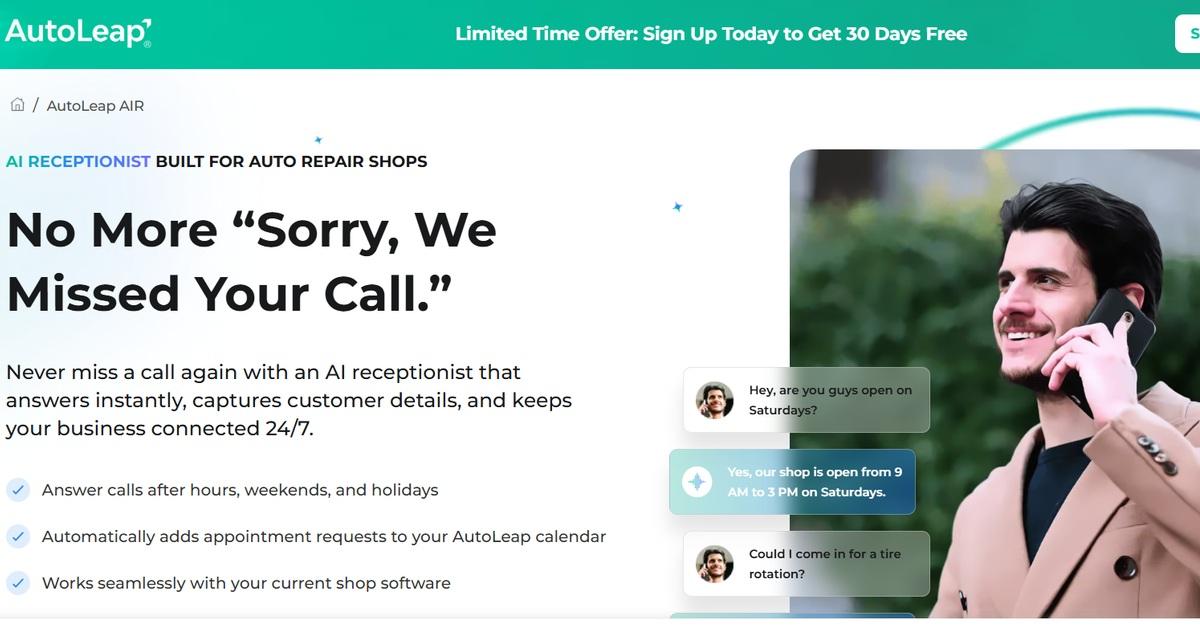
The category-level shift addressing this gap is AI call handling. A specific type of software that answers when a human can't, whether that's after close, during a hold-time spike, or when the front desk is buried in walk-ins. At a functional level, three things change:
Calls outside business hours get answered instead of routed to voicemail, closing the gap where the highest-urgency calls were previously most likely to go unanswered.
Appointment requests are captured automatically, so a caller who wants to book doesn't need a human available in real time to make that happen.
Caller details are logged without manual entry, so the shop has a record of who called and why, even outside its own operating hours.
This isn't a niche upgrade. It's the same kind of infrastructure shift that moved shops off the paper appointment book a decade ago. Digital scheduling didn't get adopted because every shop had a scheduling crisis; it got adopted because customers started expecting it, and shops without it looked a step behind. AI call handling is following the same trajectory in service businesses that run on appointment volume: not a bet on new technology, but a response to a customer expectation that's already arrived.
For shop owners evaluating what this actually looks like in practice, it helps to see how the broader category of auto attendant phone systems has evolved from basic call routing to the AI-driven receptionist capabilities now becoming standard.
The Math, Recovered
Go back to the number this piece opened with. At $250 per call, a shop that recovers just 20 previously missed calls a month - roughly one a day - recovers $5,000 in monthly revenue, or $60,000 a year, without adding a single service bay or technician. That's not a new demand. It's demand the shop was already generating and losing before the call ever reached a human.
The $250-per-call figure is uncomfortable precisely because it's quiet. There's no dashboard flagging it, no customer complaint attached to it, just a caller who hung up, didn't leave a message, and never called back. For most shops, the fix isn't finding more customers. It's stopping the ones they already have from disappearing before the conversation even starts.